Fiber vs microwave backup: which resilience strategy wins in 2026
Fiber vs microwave backup compared for US enterprises. Smartnett breaks down latency, weather impact & redundancy models. Achieve 99.999% uptime today.
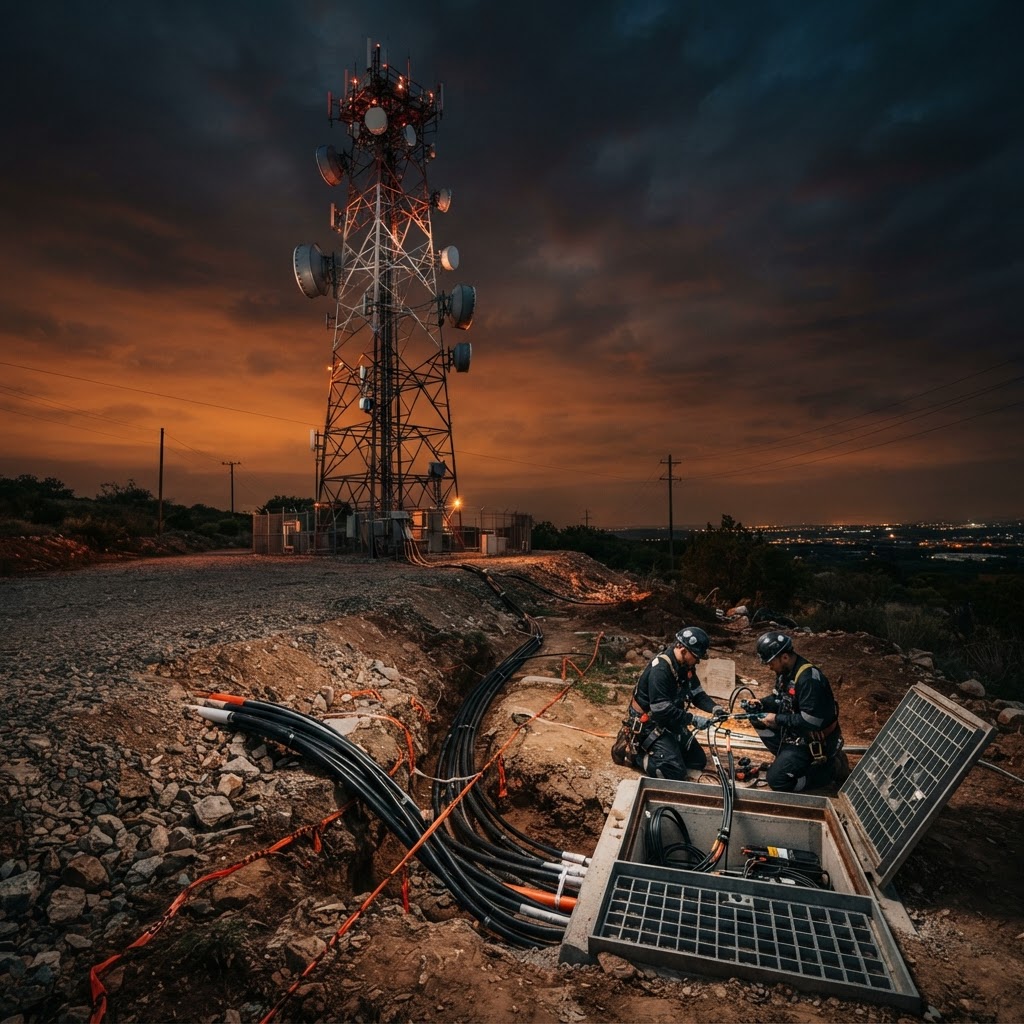
Why fiber vs microwave backup matters for enterprise networks
The fiber vs microwave backup decision is one of the most consequential choices a network architect makes when designing resilient connectivity for US enterprises, data centers, and multi-site operations. When a primary link fails, the backup medium determines whether downtime is measured in seconds or hours. Fiber optic cables deliver extraordinary bandwidth and sub-millisecond latency over long distances, but a single backhoe strike or conduit fire can sever service for days. Microwave backup links, by contrast, travel through air on licensed spectrum, taking a completely different physical path and restoring connectivity in seconds through automatic failover. Understanding the trade-offs between these two technologies—latency, capacity, weather resilience, deployment speed, and redundancy architecture—is essential for any organization targeting carrier-grade availability.
The physical diversity principle: why two paths beat one
Physical diversity is the foundation of network resilience. When your primary fiber optic circuit and your backup link share the same conduit, the same trench, or even the same building entry point, a single failure event eliminates both simultaneously. This is called a common-mode failure, and it is the leading cause of unexpected multi-hour outages in enterprise WANs, according to Gartner's network infrastructure research.
In a properly designed fiber vs microwave backup architecture, the two links are physically diverse by definition:
- Fiber optic primary: Runs underground or through aerial conduit along a specific geographic route. Typical spans range from a few city blocks to hundreds of kilometers. Intra-city routes on a backbone like Smartnett's 53,100 km fiber network achieve latency of 2–8 ms within metropolitan areas.
- Microwave backup: Propagates line-of-sight between tower-mounted antennas, typically on licensed bands between 6 GHz and 80 GHz. The signal path is entirely aerial and follows a completely different route than buried fiber, eliminating common-mode physical failure.
The Uptime Institute classifies network-level physical diversity as a Tier III requirement for data center connectivity, reinforcing that organizations subject to HIPAA, PCI-DSS, or SOC 2 compliance frameworks must architect dual-path connectivity to satisfy audit requirements.
Fiber vs microwave backup: latency and capacity compared
Latency and throughput are the two metrics that most directly affect application performance during a failover event. Here is how the two media compare across the parameters that matter most to network architects:
| Parameter | Fiber Optic (Primary) | Microwave Backup | Notes | |---|---|---|---| | Latency (intra-city) | 2–8 ms | 1–5 ms | Microwave propagates at ~99% speed of light in air vs ~67% in glass | | Latency (regional, 200 km) | 5–15 ms | 3–10 ms | Microwave advantage narrows with hop count | | Max capacity per link | 100 Gbps–400 Gbps (DWDM) | 1–10 Gbps (E-band 80 GHz) | Fiber dominates at high capacity | | Typical enterprise delivery | 300 Mbps–10 Gbps symmetric | 100 Mbps–2 Gbps symmetric | Both support dedicated bandwidth | | Jitter | <1 ms | 1–3 ms | Fiber more stable under load | | Packet loss (nominal) | <0.01% | <0.05% | Both well within VoIP thresholds | | Weather impact | Negligible (underground) | Moderate (rain fade above 18 GHz) | See weather resilience section | | Deployment time | 30–90 days (new trench) | 5–15 days (licensed spectrum cleared) | Microwave significantly faster | | Physical failure risk | Fiber cut, conduit damage | Antenna misalignment, tower ice | Different failure modes | | SLA achievable | Up to 99.999% | Up to 99.99% | Combined 1+1 exceeds 99.999% |
Sources: Cisco Live network engineering sessions, FCC licensed microwave database, Ookla Speedtest Intelligence 2024, Smartnett infrastructure specifications.
Key takeaway: fiber wins on raw capacity and jitter; microwave wins on deployment speed and physical diversity from buried infrastructure.
Weather resilience: where fiber and microwave diverge
This is the most misunderstood dimension of the fiber vs microwave backup comparison. Many network architects assume microwave is fragile in severe weather. The reality is more nuanced.
Rain fade and frequency selection
Microwave signals above 10 GHz are susceptible to rain fade—signal attenuation caused by water droplets absorbing and scattering the radio beam. The effect becomes significant above 18 GHz and is most pronounced in E-band (71–86 GHz) links. Licensed bands below 11 GHz (6 GHz, 7 GHz, 8 GHz, 11 GHz) experience negligible rain fade across spans up to 40–50 km and are widely used for internet redundancy in hurricane-prone US regions including the Gulf Coast and Southeast.
A well-engineered microwave link uses adaptive modulation: during rain events, the radio automatically steps down from 256-QAM to 16-QAM or QPSK, trading throughput for link availability. A backup link carrying 500 Mbps may drop to 150 Mbps during a heavy storm—but it remains up, which is the primary objective.
Fiber and physical weather events
Underground fiber is largely immune to rain, wind, and temperature fluctuations. However, physical weather events—flooding that saturates conduit, ice storms that snap aerial fiber spans, and hurricanes that damage manholes and vaults—are the leading cause of fiber outages in the US, according to FCC Network Outage Reporting System (NORS) data. The February 2021 winter storm Uri caused widespread fiber outages across Texas precisely because underground conduit infrastructure was damaged by ground movement and flooded vaults.
Conclusion: in catastrophic weather scenarios, microwave and fiber fail for different reasons. A 1+1 active redundancy architecture using both media simultaneously provides the highest resilience across all weather scenarios.
Active redundancy (1+1 simultaneous) vs passive backup (failover)
The redundancy model is as important as the media selection. There are two primary architectures:
1+1 Active simultaneous (hot standby)
In 1+1 active redundancy, both the fiber primary and the microwave backup carry live traffic simultaneously. The router or SD-WAN edge device monitors both paths in real time and load-balances or selects the best path per application class. When one path degrades or fails, automatic failover is instantaneous—typically under 50 milliseconds with modern SD-WAN platforms—because the backup path is already active and routing state is synchronized.
This is the architecture required for:
- Healthcare organizations under HIPAA that cannot tolerate session drops during patient data transmission
- Payment processors under PCI-DSS that must maintain continuous transaction integrity
- SaaS platforms pursuing SOC 2 Type II availability controls
Passive backup (cold failover)
In passive backup, the microwave link is dormant until the fiber primary fails. A monitoring daemon detects the outage and brings up the backup interface. Failover time ranges from 30 seconds to 5 minutes depending on routing protocol convergence (BGP reconvergence alone can take 90–180 seconds by default). During this window, sessions drop, VPN tunnels collapse, and VoIP calls disconnect.
Passive backup is lower cost but introduces recovery time objective (RTO) risk that is unacceptable for most enterprise and data center applications. For organizations with aggressive RTO requirements—under 10 seconds—1+1 active is the only viable model.
Deployment speed: the microwave advantage for urgent connectivity
One of the most compelling arguments for microwave in a fiber vs microwave backup evaluation is deployment speed. Smartnett's 96-hour installation commitment for microwave-based connections is achievable because the technology requires no civil works, no trenching permits, and no conduit coordination.
Typical deployment timelines:
- New fiber trench (greenfield): 45–90 days including permitting, civil works, splicing, and testing
- Fiber on existing conduit (brownfield): 15–30 days
- Licensed microwave (spectrum already held): 5–10 days for antenna installation and alignment
- Unlicensed microwave (60 GHz, short span): 2–5 days
For enterprises opening new facilities, recovering from a fiber cut, or establishing cross-border connectivity on the US–LATAM corridor, microwave backup can be operational while the primary fiber circuit is still being provisioned. This is particularly valuable on routes between US border cities and Mexican or Central American hubs where fiber diversity is limited.
SD-WAN integration: orchestrating fiber and microwave intelligently
SD-WAN platforms transform a static fiber-plus-microwave architecture into an intelligent, policy-driven network. Rather than simple failover, managed SD-WAN enables:
- Application-aware routing: Real-time video conferencing stays on the low-jitter fiber path; bulk backup traffic uses microwave when fiber capacity is constrained
- Continuous path monitoring: BFD (Bidirectional Forwarding Detection) probes both paths every 300 ms, detecting degradation before it becomes an outage
- Zero-touch failover: Sub-50 ms switchover without operator intervention, supporting SLA 99.99% and above
- WAN optimization: Deduplication and compression on the microwave backup link compensate for its lower throughput ceiling
- Centralized visibility: A single pane of glass across all sites, including multi-site US operations and US–LATAM backbone connections
For enterprises running dedicated internet access across multiple locations, SD-WAN eliminates the complexity of managing separate fiber and microwave circuits independently while delivering the performance guarantees that dedicated internet services require.
Compliance implications: HIPAA, PCI-DSS, and SOC 2
US regulatory frameworks increasingly treat network resilience as a technical safeguard requirement, not merely a best practice.
HIPAA Security Rule (45 CFR §164.312)
The contingency plan standard requires covered entities to maintain data backup and disaster recovery procedures. A single fiber circuit without backup fails this standard if the organization cannot demonstrate an alternative transmission path for electronic protected health information (ePHI). A documented, tested 1+1 fiber-plus-microwave architecture directly satisfies this requirement.
PCI-DSS v4.0 (Requirement 12.3)
The targeted risk analysis requirement mandates that organizations assess the impact of connectivity failures on cardholder data environment (CDE) availability. Microwave backup with automatic failover sub-50 ms provides a documented control against payment processing interruption.
SOC 2 Type II (Availability Trust Service Criterion)
SOC 2 auditors evaluate whether the organization has implemented internet redundancy controls commensurate with availability commitments. A fiber primary with microwave backup and a documented RTO under 60 seconds is a strong positive finding during availability criterion testing.
How Smartnett helps enterprises design fiber vs microwave backup architectures
Smartnet Telecom (smartnett.us) delivers carrier-grade connectivity infrastructure specifically designed for the resilience requirements of US enterprises, data centers, and multi-site operators:
-
53,100 km fiber backbone with 220 PoPs: Smartnett's fiber optic network provides the primary dedicated internet access layer with intra-city latency of 2–8 ms, speeds from 300 Mbps to 10 Gbps symmetric, and a SLA 99.999% guarantee backed by a 24/7 NOC. The network's 16 international connections and 400 Gbps international capacity make it a natural anchor for the US–LATAM backbone.
-
96-hour microwave backup provisioning: For enterprises that need backup connectivity faster than fiber deployment allows, Smartnett provisions licensed microwave links within 96 hours of order confirmation, providing immediate physical diversity while fiber infrastructure is built out.
-
Integrated managed SD-WAN with automatic failover: Smartnett's managed SD-WAN service orchestrates fiber and microwave paths in a 1+1 active configuration, delivering sub-50 ms automatic failover without requiring the customer to manage routing policy. Dedicated bandwidth is guaranteed on both paths, with fixed public IP addressing maintained across failover events.
-
Compliance-ready documentation: Smartnett provides SLA certificates, network diversity diagrams, and failover test reports formatted for HIPAA, PCI-DSS, and SOC 2 audit submissions, reducing the compliance burden on the customer's IT and security teams.
Frequently asked questions about fiber vs microwave backup
What is the main advantage of microwave backup over a second fiber circuit?
Microwave backup provides physical path diversity that a second fiber circuit often cannot guarantee. Two fiber circuits from different carriers may still share the same conduit, manhole, or building entry. A microwave link travels through air on a completely different path, eliminating common-mode failures. Deployment is also typically 5–10 times faster than provisioning new fiber.
How much capacity does a microwave backup link typically deliver?
Modern licensed E-band (80 GHz) microwave links deliver 1–10 Gbps over spans up to 3 km. Sub-11 GHz links deliver 100 Mbps–1 Gbps over 20–50 km spans. For most enterprise business internet backup scenarios, 500 Mbps–1 Gbps is sufficient to maintain critical application traffic during a fiber outage while primary dedicated internet capacity is restored.
Can SD-WAN manage both fiber and microwave backup simultaneously?
Yes. SD-WAN platforms like those integrated in Smartnett's managed service run BFD health probes on both paths continuously. In 1+1 active mode, traffic is distributed across both links based on application policy. Failover occurs in under 50 ms when either path degrades, maintaining session continuity for VoIP, video conferencing, and real-time database transactions without operator intervention.
How does fiber vs microwave backup affect compliance with HIPAA and SOC 2?
Both HIPAA's contingency plan standard and SOC 2's availability criterion require documented internet redundancy controls. A fiber primary plus microwave backup with tested automatic failover under 60 seconds satisfies both requirements. Smartnett provides diversity certification and failover test documentation that can be submitted directly to auditors, simplifying the evidence-gathering process for business internet compliance reviews.
Conclusion: building a resilient fiber vs microwave backup strategy
The fiber vs microwave backup decision is not a binary choice between two competing technologies—it is a complementary architecture that combines the strengths of both:
- Deploy fiber optic as the primary dedicated internet access layer for maximum throughput (up to 10 Gbps symmetric), minimum jitter (<1 ms), and carrier-grade SLA 99.999%
- Add licensed microwave backup on a physically diverse path for 96-hour deployment speed, aerial route separation, and resilience against fiber infrastructure events
- Implement 1+1 active redundancy via managed SD-WAN to achieve sub-50 ms automatic failover and eliminate passive backup RTO risk
- Document both paths for HIPAA, PCI-DSS, and SOC 2 audits to demonstrate compliance-ready internet redundancy
- Validate dedicated bandwidth guarantees on both links to ensure backup performance matches primary application requirements
- Request a feasibility study from Smartnett to assess physical route diversity, microwave spectrum availability, and SD-WAN integration options for your specific multi-site or data center topology
Written by
Eng. Diego Hernández Solís
Network Engineering — Smartnett
Networks and Telecommunications Engineer (UNAM). Leads the Smartnett 24/7 NOC. Expert in high-availability SLAs (99.999%) and automatic failover. ITIL v4 certified.